Zenmyosho-in 善名称院
Sanada-an 真田庵
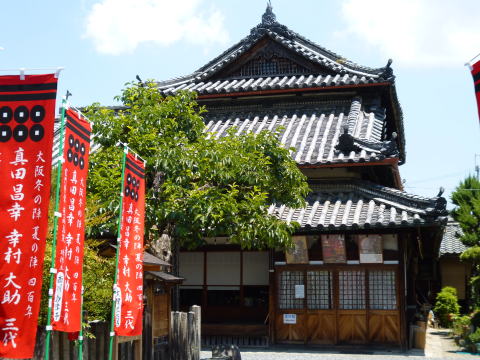
Sanada-an is located in Kudoyama Town, Ito District, Wakayama Prefecture;
officially, it is a temple of the Koyasan Shingon sect known as Zenmyosho-in.
It goes by the mountain name Karada-san,
and its principal image is the Bodhisattva Ksitigarbha (Jizo Bosatsu).
The site is traditionally believed to be
where Sanada Masayuki and his son Yukimura lived in exile after their defeat at
the Battle of Sekigahara in 1600; the temple gate features carvings of the
Sanada family crests?the "Six Coins" (Rokuren-sen) and the
"Interlocked Wild Geese" (Musubi-karigane).
The originof the temple date back to 1741,
when the monk Daian-shonin, a native of Kudoyama, converted the site of Sanada
Masayuki's grave into a temple.
Daian-shonin actively promoted the “Dosha-kaji” ritual (a rite involving
blessed sand and stones); he built a “Dosha-do” (Sand-Blessing Hall) to
house purified pebbles, and the current “San-ken-do” (Three-Bay Hall)?rebuilt
during the Edo period features a “hogyo-zukuri” (pyramidal) roof.
The main hall is built in the “yatsumune-zukuri”
style, and the roof tiles feature the chrysanthemum crest, which the temple was
permitted to use by Emperor Momozono.
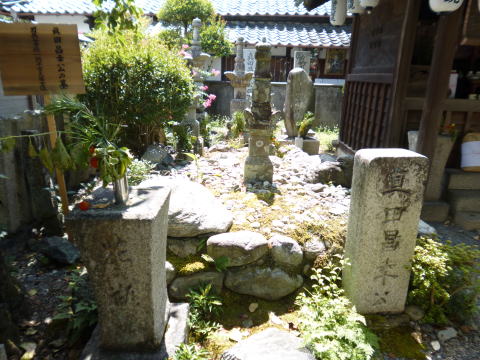
Sanada Masayuki's “Hokyoin-to”
(pagoda-style stone monument) remains on the grounds, and the site is
designated as a cultural property of Kudoyama Town under the name "Grave
of Sanada Awa-no-Kami Masayuki."
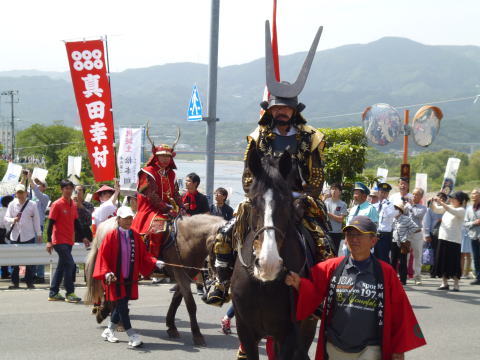
In May, the Sanada Festival is held,
centered around Sanada-an, to honor the memory of Sanada Yukimura; the event
features a procession of warriors, including the "Sanada Ten Braves"
(Sanada Juyushi).
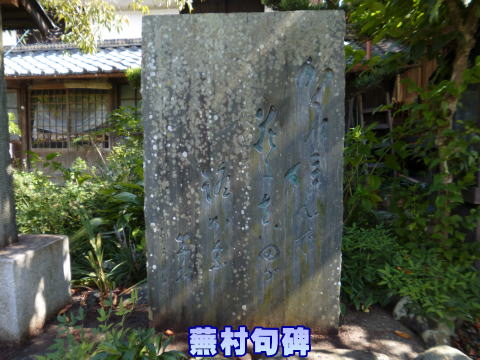
In front of the *San-ken-do* stands a stone
monument inscribed with a haiku by Buson: "Living in seclusion, one hears
the chanting of Sanada tales amidst the cherry blossoms."
Additionally, near the small wicket gate,
there is another Buson haiku monument: "Gather round the *kotatsu* and
speak of Sanada's Winter Campaign."
It is a five-minute walk from Kudoyama Station on the Nankai Electric Railway Koya Line. A municipal parking lot is located along the road on the south side.
Six coins (Rokumon-sen)
The Sanada clan of Japan's Sengoku and Edo periods used the "Rokumon-sen" (六文銭) as their family crest, which depicts six coins.
The meaning behind this crest is linked to a traditional belief in the
afterlife.
In Japanese Buddhist tradition, it was thought that when a person died,
they needed six coins to pay the ferryman to cross the Sanzu River, which
separates the living world from the afterlife.
By adopting the six coins as their crest, the Sanada clan symbolized their readiness for death, indicating their fearlessness in battle.
It was a declaration that they were always prepared to face death with
honor and would fight bravely without hesitation.
This strong connection to bravery and acceptance of mortality made the
Rokumon-sen a fitting symbol for the Sanada clan, known for their courage
and resilience.